Things to Do
Whitby jet: what it is, and how to tell it from a fake
Whitby jet is fossilised wood from the Jurassic cliffs of this coast, worked here since the Bronze Age and turned into the mourning jewellery of Victorian England. Here is what it actually is, how the trade rose and fell, and the tests that separate real jet from black glass.
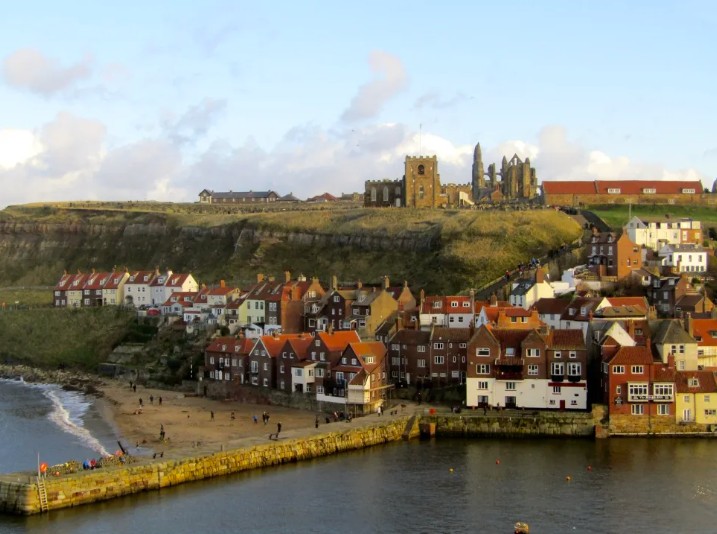
Whitby, whose cliffs and workshops gave the fossil gemstone its name.
What Whitby jet actually is
Jet is fossilised wood. The tree it came from was a species related to the Chilean pine, the monkey puzzle, Araucaria araucana. It is Early Jurassic, of Toarcian age, and the published figures cluster around 181 to 183 million years, which is close enough to say around 180 million years old and leave the false precision alone.
Whitby Museum describes it as fossilised driftwood with a secondary impregnation of bitumen drawn from the host rocks, formed by a process known as jetonisation rather than ordinary petrification. That is why it behaves nothing like stone in the hand. It is roughly 75% carbon and 12% oxygen, and its hardness on the Mohs scale runs from 2.5 to 4.0: soft enough to carve and polish with hand tools, brittle enough to chip if you drop it.
Jet is not unique to Yorkshire. It occurs in Spain, Germany, Portugal, France and Turkey as well, though only the British, Spanish and Turkish industries survive. What is particular to this coast is the length of the story: jet has been worked in Britain since the Bronze Age, while the industry, the workshops, the mines and the shop fronts, is a 19th-century thing.
The Victorian boom, and the collapse
Commercial working in Whitby dates from the 1830s, given an early boost by the death of George IV in 1830. The transformation came later. Prince Albert died in 1861, Victoria went into mourning for over forty years until her own death in 1901, and jet, black, light and carvable, became the jewellery of mourning for a whole society that followed her lead.
At the peak, between 1860 and 1880, there were over 200 jet workshops in Whitby employing around 1,500 men, women and children, supplied by some 300 mines. For a town of this size that is an extraordinary concentration of one trade.
The collapse was as sharp. Spanish imports are documented from 1874, bringing in inferior material that degraded in wear, and public confidence went with it. The fashion passed at much the same time, and by the end of the century the industry had gone. There has been a smaller revival in recent years, on nothing like the old scale, and it is that revival you are looking at in the Church Street workshops today.
How to tell real jet from an imitation
This is the question the shops have least reason to answer plainly, so here it is. The two tests you can do standing in a shop are the useful ones.
It feels warm. Jet conducts heat poorly, so it takes on the temperature of your hand almost at once. Glass feels cold and stays cold for a moment. This single difference catches most of the black glass sold as jet.
It is surprisingly light. Pick up a jet bead next to a glass one of the same size and the weight tells you immediately which is which.
The streak test is the one everybody quotes: rubbed on unglazed porcelain, jet leaves a brown streak. Say plainly what that is worth, which is not much on its own, because bog oak, vulcanite and lignite all streak brown too. A brown streak rules out glass. It does not prove jet.
The burn test exists, and real jet smells of coal. It also destroys the piece. Nobody should do it to jewellery, and no reputable seller will let you.
The imitations worth knowing by name: French jet and Vauxhall glass, both black glass; vulcanite, also called ebonite, which fades with age from black towards a dull brown-green; bog oak; and anthracite. Where to buy from the established jet shops and the working jetworks is in our Whitby shopping guide.
Where to see it
Whitby Museum, in Pannett Park, founded in 1823, is the place. It holds over 500 Victorian jet pieces, one of the best collections of Victorian jet in the world, including two jet chess tables, one of them designed by John Sherwood and begun in 1895. It is a proper old-fashioned museum, and the jet sits alongside the fossils that came out of the same cliffs.
The Museum of Whitby Jet and the working jetworks on Church Street are described on our shopping page, where you can also watch pieces being cut. Opening times and admission change from season to season, so check each museum's own website before you travel rather than trusting a page like this one.
Looking for jet on the beach
Jet is found as sea-washed pieces on the foreshore between Whitby and Ravenscar, turned out of the cliffs by the sea and rolled along the beach. Two things matter more than the finding. The cliffs on this stretch are unstable and actively fall, so digging into a cliff face is genuinely dangerous, and the tide cuts off stretches of this coast, so check tide times before you walk out and give yourself an exit. Rules about what may be collected and on whose land vary along the coast and I have not verified them, so ask locally first. The same ground and the same cautions are covered in our fossil hunting guide.
Whitby jet: your questions answered
What is Whitby jet?
It is fossilised wood, from a species related to the Chilean pine or monkey puzzle, Araucaria araucana. Whitby Museum describes it as fossilised driftwood with a secondary impregnation of bitumen from the rocks around it, formed by a process called jetonisation rather than ordinary petrification. It is roughly 75% carbon and 12% oxygen, and soft enough to carve by hand.
How old is Whitby jet?
Early Jurassic, of Toarcian age. Published figures put it at around 181 to 183 million years, so around 180 million years old is the honest way to say it. It comes out of the same rocks that give this coast its ammonites and fossil reptiles.
How can you tell if Whitby jet is real?
Real jet feels warm rather than cool, because it conducts heat poorly, where glass feels cold at once. It is also surprisingly light for its size. Rubbed on unglazed porcelain it leaves a brown streak, though that alone proves nothing, because bog oak, vulcanite and lignite all streak brown too. The burn test, in which real jet smells of coal, destroys the piece and should never be done to jewellery.
What is fake Whitby jet made of?
The imitations worth knowing are French jet and Vauxhall glass, both black glass and both cold and heavy in the hand; vulcanite, sometimes called ebonite, which fades with age; bog oak; and anthracite.
Where can you see Whitby jet?
Whitby Museum in Pannett Park, founded in 1823, holds over 500 Victorian jet pieces, one of the best collections of Victorian jet anywhere, including two jet chess tables, one of them designed by John Sherwood and begun in 1895. The Museum of Whitby Jet and the working jetworks on Church Street are the other places to see it, and those are covered on our Whitby shopping page.
Can you find jet on the beach at Whitby?
Jet turns up as sea-washed pieces on the foreshore between Whitby and Ravenscar. The cliffs along that stretch are unstable and fall regularly, digging into a cliff is dangerous, and the tide cuts off sections of this coast, so check tide times and stay off the cliff face. Rules about collecting vary and we have not verified them, so ask locally before you pocket anything.