Seasons
When is the heather in bloom on the North York Moors, and where to see it
By Jon Cosson · Updated 10 October 2026
The short answer: bell heather starts in late July, the ling that covers most of the moor turns purple from the second week of August, the big views are at their best from about 15 August to the end of the month, and the colour holds into the first week of September before fading. In a hot, dry year like 2026 it runs early, by a week or two. This page gives the week-by-week pattern, the viewpoints where you can see it from the car and where to park, the rules, and the reasons the moors look like this at all.
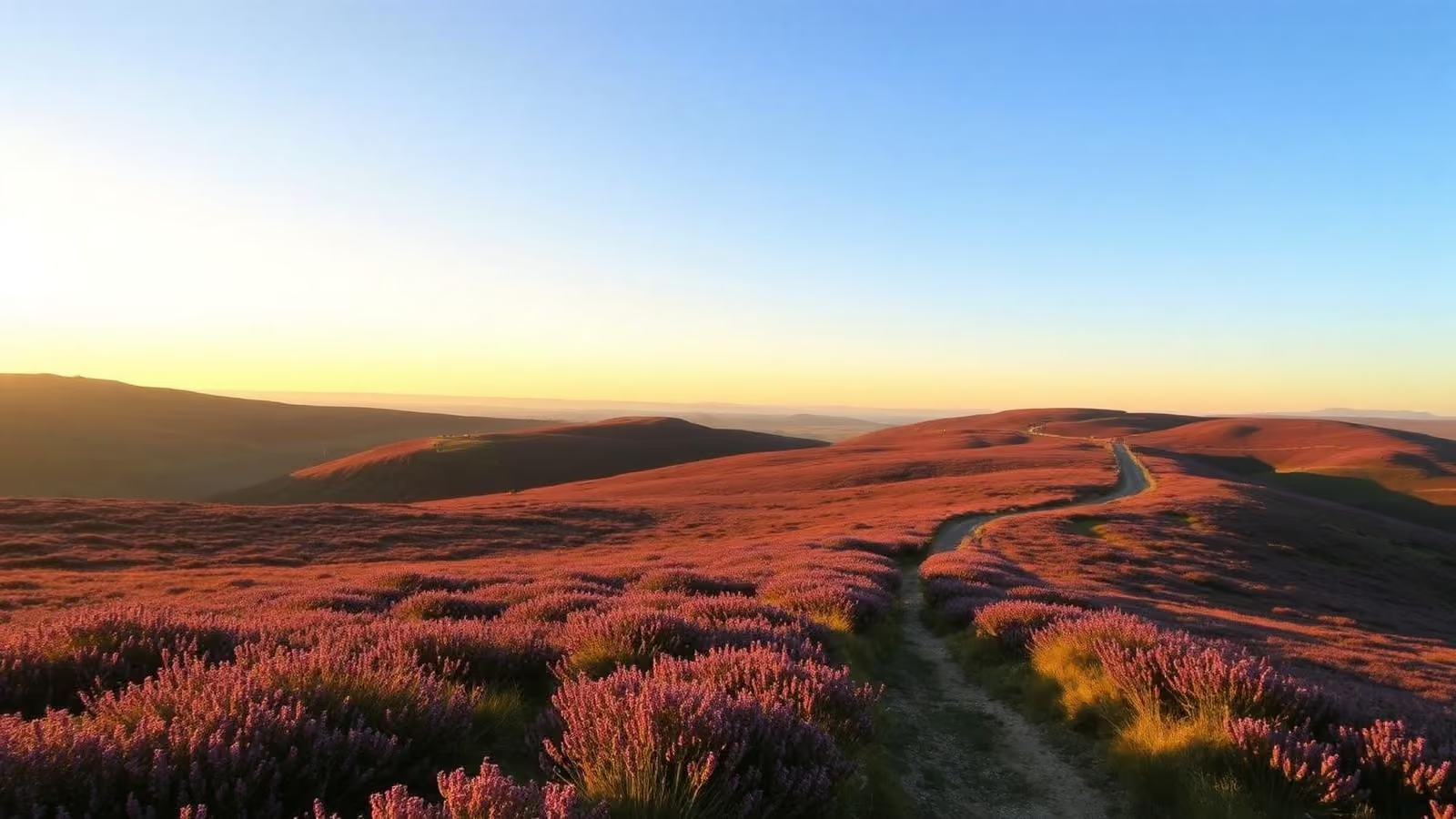
The three heathers
The North York Moors has one of the largest continuous expanses of upland heather moorland in England and Wales: over 44,000 hectares, about a third of the National Park, by the Park Authority's figure. The statutory citation for the North York Moors Special Area of Conservation calls it “the largest continuous tract of upland heather moorland in England”. Three plants make the colour.
| Heather | What it looks like | When it flowers |
|---|---|---|
| Bell heather (Erica cinerea) | Dark pink to purple bells, leaves in threes, on dry banks and rocky edges | Late July, first to flower |
| Ling (Calluna vulgaris) | Tiny pale pink to purple flowers in dense spikes; the plant that covers most of the moor | Mid to late August, the main display |
| Cross-leaved heath (Erica tetralix) | Pale pink bells at the shoot tips, leaves in fours, in boggy ground | July to September, in the wet hollows |
The sequence matters. The deep purple patches you see in early August are bell heather on the edges. The sea of colour across the tops is ling, and it comes two to three weeks later.
Week by week
The National Park's own wording is that the heather is at its best “from mid to late August and into September”. The Park does not publish dates for each species; the pattern below is from the botanical sources and from what was reported on the moor in 2025 and 2026.
| Week | What to expect |
|---|---|
| 20 to 31 July | Bell heather flowering on dry banks and crags. Ling in bud. In a hot year (2026) ling opens in the last week of July. |
| 1 to 7 August | Bell heather at its peak. Ling starting on the lower, drier, south-facing moor. Cross-leaved heath pink in the bogs. |
| 8 to 14 August | Ling colouring widely; the first purple haze from the roads. Grouse shooting opens on 12 August and may bring short closures of access land. |
| 15 to 21 August | The Park's stated start of the peak. In a normal year this is the best week for the big views. |
| 22 to 31 August | Peak holds. Bell heather browning. The smell of honey and the bees are strongest. |
| 1 to 7 September | Full colour still on the high ground and north-facing slopes; lower moors fading to mauve and brown. |
| 8 to 14 September | The Park says “holding on”. Patchy colour, good light, low sun. In an early year it is over. |
2026 was early. After the UK's hottest summer on record and England's driest July, a local moorland diarist reported ling in flower above Hutton-le-Hole in the first days of August, a week or two ahead of the usual date. 2025, with a very warm, dry spring, also ran early. A cool, wet summer does the opposite. We will update this page each July with what the moor is doing.
Where to see it, and where to park
Prices are the National Park Authority's car park tariffs published 1 September 2026, reviewed each April. Card or PayByPhone only in the Park's car parks.
| Viewpoint | From the car? | Parking | Walk | Photograph it |
|---|---|---|---|---|
| Hole of Horcum and Levisham Moor | Yes, the whole bowl from the A169 lay-bys and the car park | Saltergate car park, YO18 7NS, 7.8 miles north of Pickering on the A169; £3.90 up to two hours, £6.20 over; accessible viewing platform a short walk away; Coastliner 840 stops here | Levisham Moor and Hole of Horcum circuit, or the short walk to Skelton Tower | The bowl faces east, so morning light fills it; evening light catches the rim |
| Blakey Ridge and the Lion Inn | Yes, for the whole length of the Hutton-le-Hole to Castleton road | The Lion Inn car park for customers; roadside pull-ins elsewhere; no Park car park and no postcode you can trust | Lion Inn to Chimney Bank Top and Hutton-le-Hole, 8.5 miles on the old ironstone railway | Ridge top, 360 degrees: sunrise over Rosedale, sunset over Farndale |
| Spaunton Moor above Hutton-le-Hole | Yes, on the road north out of the village | Hutton-le-Hole car park, YO62 6UB; £4.65 up to three hours, £6.20 over; toilets; six EV chargers | Four-mile circular to Lastingham | Afternoon light from the village side |
| Rosedale Chimney Bank top | Yes, from Bank Top | Bank Top, YO18 8SE, at the top of the 1 in 3 hill; not on the Park's charging list, so expect it to be free but confirm on the day | Miles without Stiles route along the old mineral railway past the kilns | Kilns in the foreground, Rosedale below; morning light |
| Fylingdales Moor and the A171 | Yes, from the A171 and the Ravenscar road | A171 lay-bys; Ravenscar village roadside | Ravenscar to Robin Hood's Bay over Howdale Moor | Coast behind, evening light from the west. The western side of Fylingdales burnt in the 2025 wildfire and is recovering; the coastal side is intact |
| Goathland Moor | Yes, on the Goathland to Egton Bridge road and the road to the A169 | Goathland car park, YO22 5LX, £4.65 flat rate; toilets | Rail Trail, or the six-mile leaflet walk over Wheeldale Moor | The moor edge above the village in the evening |
| Westerdale and Castleton Rigg | Yes, along the Castleton to Blakey road | Informal pull-ins only | Esk Valley Walk sections | Faces east over Westerdale, so late afternoon side light |
| Danby Beacon | Yes, from the beacon | Small informal parking at the beacon; Danby Lodge car park, YO21 2NB, £3.90 up to two hours, £6.20 over, with toilets, cafe and eight EV chargers | Walks around Danby Lodge booklet | 360 degrees from 299 metres |
| Sutton Bank and the Hambleton Hills | The famous view is of the Vale of York, not heather; the heather is behind you on Hawnby side | Sutton Bank National Park Centre, YO7 2EH, £3.90 up to two hours, £6.20 over; open daily 10am to 5pm until 1 November 2026 | Hawnby Hill and Easterside Hill | Drone flying is restricted here: it is inside the airfield zone |
| Newtondale from the train | Yes, from the carriage window between Levisham and Goathland | Pickering or Grosmont car parks (Grosmont YO22 5QE, £3.90 and £6.20) | Six-mile forest circuit from Newtondale Halt, a request stop | Sit on the left heading north |
Other Park-listed viewpoints with heather around them: Cowhouse Bank above Bransdale, Clay Bank on the B1257, and Blue Bank on the A169 above Sleights.
The rules
- Most of the moor is open access land, marked with an orange border on OS Explorer OL26 and OL27. You may walk off the paths, on foot only. Landowners can close access land for a limited number of days a year under the Countryside and Rights of Way Act, often at short notice, and shooting days are the usual reason in August and September; rights of way stay open.
- Dogs are not allowed to roam on most moorland open access land. Keep to the rights of way, on a short lead so the dog cannot leave the line of the path, from 1 March to 31 July for ground-nesting birds and near livestock at any time. A dog worrying sheep can lawfully be shot.
- No barbecues, no campfires, no cigarette ends out of car windows. The 2025 Langdale and Fylingdales fire, the biggest in the National Park's history, covered up to 25 square kilometres at its peak, and the fire service believes it started with cooking over a naked flame. The Park can suspend open access after a fire, as it did until December 2025.
- Stay on the obvious paths on Fylingdales Moor; the fire exposed unexploded ordnance from its years as a military range, and the Park says do not touch metal objects.
- Do not park on verges or in gateways. Farm and emergency vehicles need them, and verges hold nesting birds.
- Drones: you need the landowner's permission to take off and land, and the Park Authority will not give it for its own land, which includes the car parks and the National Park Centres.
- Do not stack stones on the ancient cairns and crosses; many are scheduled monuments.
Why the moors look like this
Heather moorland is not a natural landscape. The Park Authority's own Landscape Character Assessment describes moor managed for grouse since the later nineteenth century, burnt in small patches on a cycle so that new shoots grow, and grazed by sheep. Most of it is privately owned.
Grouse moors are kept in a patchwork by burning or cutting small areas of old heather in winter so that young shoots grow for the birds to eat. A Fylingdales landowner, writing for the Moorland Association, says Natural England consents set the cycle at 17 to 25 years on protected moor, argues that many moors now burn or cut more often, and blames the fuel left standing on Fylingdales for how far the 2025 fire ran. Natural England's response to the 2025 consultation said burning should be seen as a last resort, and since 30 September 2025 a Defra licence is needed to burn on peat deeper than 30 centimetres anywhere in a Less Favoured Area, with the season limited to 1 October to 15 April. The Committee on Climate Change called for a ban on rotational burning in 2020, and local campaigners favour cutting instead. We state the positions; we do not pick one.
Much of the moor has shallow peat, but around 5,500 hectares in the centre is deep peat, more than 40 centimetres and up to six metres in places, which is why the burning rules matter here.
Honey, bilberries, adders and ticks
- Beekeepers bring hives up onto the moor in late summer and take them off in September heavy with heather honey, which the Park's own honey producers describe as richer and more floral than lowland honey. Look for it at farm shops.
- Bilberries fruit among the heather from late July; the black berries with a blue bloom make a good tart.
- Adders live on the moor, and Fylingdales in particular. You are most likely to see one basking on a path in spring. Bites are rare but can be serious; get medical help, and take a bitten dog straight to a vet.
- Ticks come off the bracken. Long sleeves, trousers tucked in, a check when you get home, and a tick tool rather than fingers. A spreading bull's-eye rash means a doctor.
Heather FAQs
- When is the heather in bloom on the North York Moors?
- From mid-August into early September for the main display of ling, with bell heather from late July. In a hot dry year it runs about two weeks early; 2026 was reported early, with ling in flower in the first days of August.
- Where is the best place to see the heather?
- The Hole of Horcum from the Saltergate car park on the A169, Blakey Ridge on the road from Hutton-le-Hole to Castleton, and Rosedale Chimney Bank top. All three can be seen from the car.
- Can I walk my dog on the moors in August?
- On the rights of way, on a short lead. Dogs are not allowed to roam on most of the open access moorland, and shooting days can close access land at short notice.
- Why do they burn the heather?
- To keep a patchwork of young heather for red grouse and sheep. Burning is now licensed on deep peat and restricted to 1 October to 15 April; the alternatives and the arguments are set out above.
Sources: North York Moors National Park Authority: All about heather, Moorland, About moorland, nature calendar for July, August and September (updated 15 July and 19 August 2026), Facts and figures (19 August 2026), Landscape Character Assessment LCT1 (December 2021), Hole of Horcum (19 June 2026), Hutton-le-Hole (19 August 2026), Goathland (4 September 2026), Danby (16 February 2026), Rosedale Abbey, accessible viewpoints (5 March 2026), car park list (1 September 2026), open access land and walking with dogs (30 August 2023), Share with care (12 June 2026), staying safe (4 August 2026), wildfire (21 July 2026), drones (30 August 2023); JNCC, North York Moors SAC citation; Moorland Association, accounts of the Fylingdales fire (6 October 2025, 19 June 2026); North Yorkshire Fire and Rescue, cause of the Langdale and Fylingdales fire (26 February 2026); Natural England, response to the Defra burning consultation (3 October 2025); gov.uk, heather and grass burning licences (30 September 2025); Met Office summer 2025 and summer 2026 statistics; Fhithich moorland diary, 25 June 2025 and August 2026; Yorkshire Post, 31 March 2020. Checked 10 October 2026.
Where to stay in the North York Moors
Self-catering cottages, village inns and farmhouse boltholes right across the moors, from the southern villages to the coast.
Browse places to stay