Villages & Places
Staithes
By Jon Cosson · Updated 19 October 2026 · Checked 10 October 2026
Staithes is a fishing village where Staithes Beck meets the sea, nine miles north of Whitby. Visitors park at the top. The old village and harbour are reached on foot down steep, narrow cobbled streets. James Cook worked in a shop here before going to sea. Painters settled here in the 1890s. CBeebies filmed Old Jack's Boat on the harbourside. This guide starts with parking and tides.
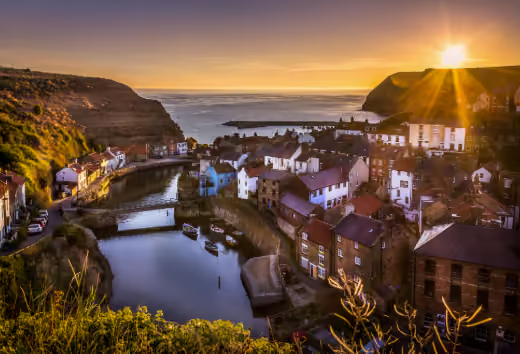
The classic view over Staithes, where cottages gather around the sheltered harbour between two headlands.
Things to do in Staithes
The main things to do in Staithes, North Yorkshire, in brief:
- Captain Cook: the plaque, the heritage centre and the museum's shop reconstruction.
- The Staithes Group: the painters' colony, galleries and the September festival.
- The harbour and cobles: the fishing boats still drawn up by the beck.
- Cleveland Way walks: cliff paths to Port Mulgrave, Runswick Bay and Saltburn.
- Boulby: the highest cliff on the east coast and the mine beneath it.
Before you go: the practical facts
- Parking
- Bank Top car park, Staithes Lane, TS13 5AD, North Yorkshire Council. 122 spaces and four coach bays. Charges apply 9am to 6pm from 1 March to 31 October: As Sandsend: 1hr £3.20, 2hrs £4.90, 4hrs £6.40, 6hrs £7.30, 24hrs £8.70 (1 March to 31 October; free outside the season); free from November to the end of February. Blue Badge holders park free with the badge displayed. Four electric charging points, which the National Park describes as for residents. Pay by cash, contactless, RingGo or by entering your registration. No overnight sleeping in vehicles. The private car park next to it has a different operator and its own tariff; read the signs before you leave the car.
- There is no vehicle access to the old village for visitors. The walk down from Bank Top is steep and takes about ten minutes; the walk back up takes longer.
- Toilets
- at the Bank Top car park (Whitegate Close, TS13 5BB) and at Bank Bottom by Seaton Garth (TS13 5DH). Both open 8am to 9pm from April to October and 8am to 6pm from November to March, with accessible cubicles; the National Park says a RADAR key is needed.
- Cash and post
- cash machine at the Co-op on Whitby Road at the top of the village. The Post Office is a mobile service at the Gateway Centre, Whitegate Close, on Mondays from 11.15am to noon only.
- Buses
- Arriva X4 and X4A between Whitby and Middlesbrough by way of Saltburn, about every 30 minutes in the daytime, stopping at Captain Cooks Close, Dalehouse, by the Bank Top car park. From 30 August 2026 there is a new 7.10pm journey from Middlesbrough to Whitby, Monday to Saturday, and a later Sunday evening journey from Whitby at 8.43pm. No railway: the station closed in 1958. Whitby and Saltburn are the nearest.
- Dogs
- welcome in the village, on the Cleveland Way and in the museum.
- Tides
- the beach and the rocks at the harbour mouth flood at high water. Check the tide times before you go round to Port Mulgrave or on to the rocks.
- Mobile signal and card payments in the old village are unreliable; take some cash.
See buses to and from Whitby for X4/X4A route guidance and live timetable links.
Visitors use the pay-and-display car park at the top of the village, which has toilets. Only residents' cars may go down to the harbour.
The walk down, and what you will find
Staithes Lane drops from Bank Top to the beck in a few hundred yards. At the bottom the High Street runs along the north bank to the harbour, with the Cod and Lobster on the sea wall at the end. Across the footbridge is Cowbar, the other half of the village, which sits in Redcar and Cleveland; the beck is the boundary between the two councils. Between the houses are the alleys the village is known for, including Dog Loup, 45 centimetres wide, which the National Park calls the narrowest street in the north of England.
Staithes Museum, on the High Street (TS13 5BQ), is open daily from 10.30am to 4.30pm, last entry 4.15pm, free, and dogs are welcome. It holds a reconstruction of the street where James Cook worked, and it is the best first stop.
Captain Cook
A plaque on Church Street marks James Cook's time as a grocer's apprentice here in 1745 to 1746. The Captain Cook and Staithes Heritage Centre occupies the old Methodist chapel.
In 1745 the 16-year-old James Cook was taken on as a shop boy by William Sanderson, grocer and haberdasher, in Staithes. In 1746 he moved to Whitby and was apprenticed to the shipowner John Walker, and the rest followed. The museum's reconstruction of the shop is as close as you will get. The Captain Cook Inn at the top of the village, formerly the Station Hotel, takes the name.
The Staithes Group
From the 1880s to the First World War a loose colony of painters worked here, drawn by the light, the cobles and the fishing families: the Northern Impressionists, now called the Staithes Group. Laura Knight and her husband Harold Knight first came in 1894 and stayed until 1907, and Laura Knight's early paintings of the village are the ones most people know. The village still has working studios and galleries, and the Staithes Festival of Arts and Heritage fills cottages and boat sheds with exhibitions each September; in 2026 it ran from 11 to 13 September. The 2027 dates have not been published.
Old Jack's Boat
The CBeebies series Old Jack's Boat, with Bernard Cribbins as Jack, was set and filmed in Staithes from 2013. Jack's house is a cottage on Cowbar Bank, across the beck, and the harbour, the beck and the cobles appear throughout. The series won the Children's BAFTA for pre-school live action in 2014 and 2015. The house is a private home, so look from the lane.
Fishing, cobles and the sea
In the nineteenth century Staithes was one of the biggest fishing ports on the north east coast, with wooden cobles working from the beck by the dozen. Today a few boats work for mackerel, lobster and crab, and the cobles are still drawn up by the harbour. The cliffs on both sides were mined for alum, ironstone and jet, and the ruined harbour at Port Mulgrave, a mile south along the Cleveland Way, is where the ironstone was shipped out.
Minke whales are seen off the coast from July, with the best chance between July and the end of September; the cliff top above the village is the usual watching point, and Real Staithes runs boat trips. Calm seas help.
Boulby and the mine
Boulby Cliff, a mile north on the Cleveland Way, is 203 metres high, the highest point on the east coast of England by the National Park's reckoning. Beneath it is the Boulby mine, now producing polyhalite, and 1.1 kilometres down inside it the Boulby Underground Laboratory, where scientists have searched for dark matter since the 1990s because the rock above shields their instruments from cosmic rays. There is no public access to either.
Walks
The Cleveland Way National Trail follows the clifftop from the top of Church Street towards Port Mulgrave and Runswick Bay. Traditional cobles, the local fishing boats, are still pulled up in the harbour below.
- Staithes to Runswick Bay on the Cleveland Way: 2.5 miles by the National Park's reckoning, about 4.5 miles by the National Trail's route description, one way, easy; the X4 bus brings you back.
- Staithes and Port Mulgrave circular: 4 miles, two and a half hours, moderate, by way of Dalehouse.
- Staithes to Saltburn on the Cleveland Way: 8 miles over Boulby Cliff, with the bus back.
- Staithes to Whitby on the Cleveland Way: 10.8 miles.
- The Boulby Cliffs circular and the painted optical illusion trail by Paul Czainski are listed by the National Park.
Eating, drinking and staying
Hours are from CAMRA or the pubs' own listings and change with the season; check before you rely on them.
- The Cod and Lobster, 61 High Street, on the sea wall at the harbour: open 11am to 11pm daily, food noon to 3pm and 5pm to 9pm.
- The Royal George, High Street: 11.30am to 11.30pm Sunday to Thursday, until 12.30am on Friday and Saturday; food noon to 2.30pm and 6pm to 8pm. It has rooms.
- The Captain Cook Inn, 60 Staithes Lane, at the top of the village: rooms, free parking for guests, a house ale and monthly live music.
- The Fox and Hounds at Dalehouse, a mile inland: open from 4pm on most days, from noon on Sunday, closed Tuesday; food 6pm to 8pm.
- Cafes and galleries along the High Street.
When to come
Spring and autumn for the light and the quiet, July to September for the whales, September for the festival and the Staithes Weekender, mid-August for Lifeboat Weekend (14 to 16 August in 2026). Summer weekends fill Bank Top by late morning.
Four honest cautions
- The walk back up to the car park is steep. Allow for it with children, older legs or a full picnic bag.
- Bank Top charges from the first hour between March and October, and the private car park next to it has its own rules; do not confuse the two.
- The tide comes right into the harbour mouth and across the rocks towards Port Mulgrave.
- The Post Office is one hour a week. Bring cash for the smaller places.
Nearby
Staithes FAQs
- Can you drive into Staithes?
- No. Visitors park at Bank Top (TS13 5AD) and walk down. The old village is residents' access only.
- How much is parking in Staithes?
- As Sandsend: 1hr £3.20, 2hrs £4.90, 4hrs £6.40, 6hrs £7.30, 24hrs £8.70 (1 March to 31 October; free outside the season) at the council's Bank Top car park, charged 9am to 6pm from 1 March to 31 October and free in winter. Blue Badge holders park free.
- Where was Old Jack's Boat filmed?
- In Staithes. Jack's house is a cottage on Cowbar Bank, across the footbridge from the harbour; it is a private home.
- Is Staithes dog friendly?
- Yes. Dogs are welcome in the village, on the Cleveland Way, in the museum and in the pubs listed above.
- When can you see whales from Staithes?
- Minke whales from July to the end of September, from the cliff top or on a boat trip from the harbour.
Sources: North York Moors National Park Authority, Staithes and Port Mulgrave page (updated 5 May 2026); North Yorkshire Council, Bank Top car park Staithes (7 September 2026), off-street parking order (11 March 2026), car park permits Staithes (14 August 2026), public toilets directory (27 February 2024); Post Office branch finder; Staithes Museum; Captain Cook Society; Art Fund, Laura Knight; National Trail, Cleveland Way route descriptions; Arriva, service changes 30 August 2026, and bustimes.org for the X4 and X4A; CAMRA listings for the Cod and Lobster, the Royal George and the Fox and Hounds; Captain Cook Inn listing and the Yorkshire Post pub of the week; RNLI, Lifeboat Weekend 2026 (31 July 2026); Staithes Festival of Arts and Heritage; staithes.org.uk events (13 October 2025); UKRI, Boulby Underground Laboratory; Yorkshire Coast Nature on minke whales; BAFTA and the Whitby Gazette on Old Jack's Boat. Checked 10 October 2026.
Basing yourself for the north coast
Staithes has cottages and a couple of small inns but very little parking. Many visitors base themselves in Whitby or one of the Esk Valley villages and drive up for the day, it is only 20 minutes on the A174.
Browse places to stay