Villages & Places
Ravenscar
By Jon Cosson · Updated 18 October 2026
Ravenscar, on the North Yorkshire coast, was surveyed as a resort but never fully built. It stands six hundred feet above the sea at the southern end of Robin Hood's Bay. Empty Victorian streets, alum works remains and seals below the cliffs mark this walking headland.
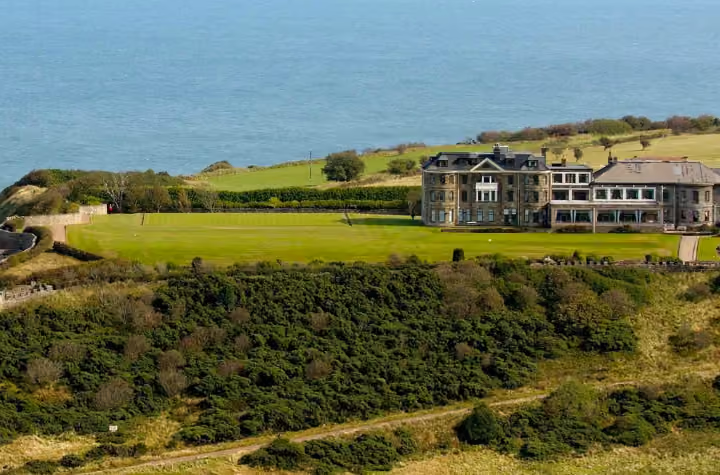
Raven Hall stands on the exposed Ravenscar headland, high above Robin Hood's Bay.
The town that never was
In the 1890s the Peak Estate Company bought the headland and set out to build a seaside resort to rival Scarborough. Streets were laid, drains and sewers dug, plots numbered and sold at auction in a blaze of promotional confidence. Then buyers arrived and discovered the problems: the sea was six hundred feet below with no practicable way down, the wind came off the North Sea unbroken, and the railway station was a long haul from the plots.
The company failed in 1913. A handful of houses were built; the rest of the resort exists only as kerbs and street lines vanishing into rough grass, which you can still walk today with the estate plan in mind. It is a genuinely eerie thing to see, and quite unlike anything else on this coast.
Peak Alum Works
The remains of Peak Alum Works lie below the village. The National Trust cares for them and tells the story of the early alum industry on this coast. The alum works trail drops onto the cliff shelf below. Alum, used to fix dye in cloth, was quarried and processed here from the 17th century in one of England's first true chemical industries, using shale, urine shipped in by the barrel and a great deal of hard labour. The quarry faces, tanks and tramway lines are still legible in the hillside.
The trail itself is open ground and free to walk at any time; it is steep, exposed and unfenced in places.
Seals, and the view
Grey seals haul out on the scars below the cliffs and can usually be picked out from the cliff-top path, take binoculars, and look in autumn and early winter when pups are on the rocks. Stay on the top: scrambling down disturbs the colony and this is not a coast that forgives a slip.
The compensation for the wind is the view. From the headland the whole sweep of Robin Hood's Bay runs north to Ness Point, with Whitby's abbey visible on a clear day, one of the great coastal panoramas in the north of England, and the reason the Cleveland Way comes this way.
Walks from Ravenscar
Ravenscar was the highest point of the old Scarborough to Whitby railway, at about 631 feet. The former line is now the Cinder Track.
Robin Hood's Bay circular (about 9 miles). North on the Cleveland Way along the cliffs to Bay Town, returning level along the Cinder Track, the old Scarborough to Whitby railway. Check the current closure notice before planning the coast leg.
The alum works and geological trail (about 2 miles). Short, steep and full of interest, down onto the cliff shelf and back. Good boots.
Hayburn Wyke (about 6 miles return). South along the Cleveland Way to a wooded cove where a waterfall drops onto the boulder beach, a small cove on the Yorkshire coast. See more in our walks section and waterfalls guide.
Practicalities
Ravenscar is a dead end reached by a signed lane off the A171. There is free roadside parking. The National Trust visitor centre has a second-hand bookshop. Its café has closed. Public toilets are across the road. There is currently no beach access after cliff falls. There is no supermarket, no petrol and patchy mobile signal. Bring what you need, wear a layer more than you think, and treat the cliff edges with respect. They are unfenced and undercut.
Ravenscar FAQs
- Why is Ravenscar called the town that never was?
- Because a Victorian company bought the headland in the 1890s and laid out a full resort to rival Scarborough, roads, drains, sewers and plots, but failed to sell them. Buyers took one look at the cliff with no beach access and the exposed clifftop position and stayed away. The empty streets are still there in the grass.
- Is there a beach at Ravenscar?
- Not in any usable sense. The headland stands roughly 600 feet above the sea with no easy way down; the path from Ravenscar golf course to the beach is closed by a landslip, and there is no way up the cliff for anyone walking along the beach from Robin Hood's Bay or Boggle Hole. Seals are watched from the clifftop. For sand, go to Robin Hood's Bay, Runswick Bay or Sandsend instead.
- Can you see seals at Ravenscar?
- Yes, a grey seal colony hauls out on the rocks below the cliffs, and they are often visible from the cliff-top path with binoculars, especially in autumn and winter around pupping time. Watch from above: going down to them disturbs the colony and the descent is dangerous.
- What is there to do at Ravenscar?
- Walk. The alum works trail on the cliffs below, the geological trail, the seal viewpoints and the level Cinder Track to Robin Hood's Bay are all here, along with a hotel and clifftop views over the whole bay.
- How do you get to Ravenscar?
- By car, a signed turn off the A171 Whitby-to-Scarborough road, ending in a dead end at the headland. There is no through route. On foot it is on the Cleveland Way and the Cinder Track, roughly five miles from Robin Hood's Bay and eleven from Scarborough.
Nearby
Checked October 2026: National Trust Yorkshire Coast; Council Bank Top parking; Council Station parking.
Staying on this stretch of coast
Ravenscar itself has a hotel and a few holiday lets and very little else. Robin Hood's Bay, Whitby and Scarborough all put it within half an hour, and the Cinder Track links them without a car.
Browse places to stay