Things to Do
Rievaulx Abbey
By Jon Cosson · Updated 17 October 2026
A valley chosen for its silence, and a ruin that still enforces it. Founded in 1132 as the first Cistercian abbey in the north, Rievaulx grew into one of the richest houses in England and left behind the finest monastic architecture in the country. Three storeys of pointed arches standing open to the Yorkshire sky.
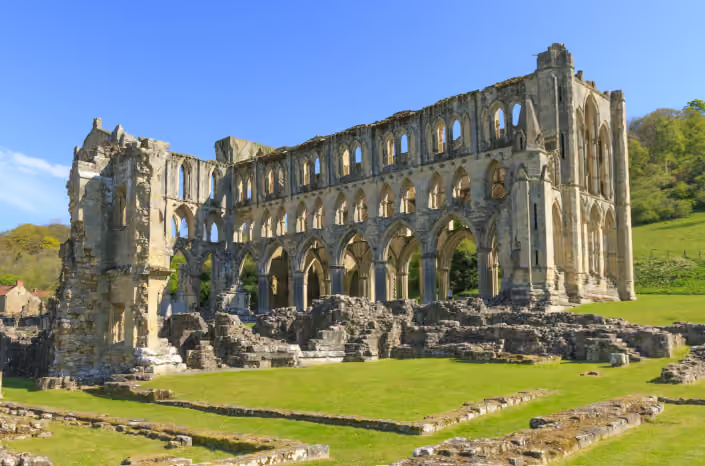
Rievaulx Abbey's soaring presbytery still rises to three storeys above the valley floor.
What you are looking at
The Cistercians came to Rievaulx in 1132, sent from Clairvaux to found the order's first house in northern England, and deliberately chose a narrow wooded valley on the River Rye, remote, awkward and out of the world. It did not stay quiet for long. Under its third abbot, Aelred (1147 to 67), a writer whose books on friendship are still read, the community grew to hundreds of monks and lay brothers and ran an economic empire of sheep, ironworking and mines across the moors.
The abbey is oriented oddly, roughly north to south rather than east to west, because the valley allowed nothing else. The showpiece is the presbytery of the 1220s, three storeys of Early English arcading, triforium and clerestory left standing to near full height; walk to the far end and turn round before you do anything else. Beyond it lie the nave, chapter house, refectory, infirmary and the great drainage works the monks built to bend the river out of their way.
Henry VIII dissolved the abbey in 1538; the lead came off the roofs and the buildings were quarried for stone. What survived is now cared for by English Heritage, with a museum of finds and a cafe on site.
Rievaulx Terrace
On the hillside above, the Rievaulx Terrace is an entirely separate pleasure: a half-mile grassed terrace laid out in the 1750s by the Duncombe family with two classical temples at either end, designed so that eighteenth-century visitors could stroll along and admire the ruins below as a picturesque object. It is run by the National Trust, has its own entrance, car park and charge, and there is no direct path down to the abbey, you drive between the two.
The view from the terrace is the classic photograph of Rievaulx, and in autumn it is one of the best colour walks in the park.
Practicalities
Allow around two hours for the abbey and museum, or half a day to add the Terrace and lunch in Helmsley. Both sites are seasonal in their opening, with shorter winter hours, check English Heritage and National Trust listings on the day. There is a car park at the abbey; the approach lanes from Helmsley and Scawton are single-track with passing places and are not the place to hurry.
Much of the abbey site is level grass and gravel, though the ground is uneven in places. Dogs on leads are generally welcome in the grounds, see our dog-friendly guide.
Walking there from Helmsley
The best arrival is on foot. From Helmsley market place, the Cleveland Way heads out west and a signed path drops to Rievaulx in about three miles of field, wood and river. The same approach the monks used, and the abbey stays hidden until the last few hundred yards. Walk out, look round, and take the lane or a taxi back if legs are short.
What to combine it with
Rievaulx sits at the heart of the finest cluster of historic sites in the park: Helmsley Castle and the walled garden in the town, Byland Abbey and Ampleforth to the south-west, and Mount Grace Priory near Osmotherley. Our abbeys and castles guide strings them into a day, and Sutton Bank is fifteen minutes away for the view afterwards.
Rievaulx Abbey FAQs
- Is Rievaulx Abbey worth visiting?
- Yes, it is one of the most complete and most beautiful monastic ruins in Britain, set in a wooded valley that hides it until you are almost on top of it. The soaring three-storey presbytery is the single finest piece of Cistercian architecture left in England. Allow two hours, or half a day with the Terrace.
- Who runs Rievaulx Abbey and is it free?
- English Heritage runs the abbey and museum, with an admission charge; members enter free. Rievaulx Terrace above the valley is separate and run by the National Trust, with its own charge and entrance. Check current prices and opening hours before you travel, as both are seasonal.
- When was Rievaulx Abbey founded?
- In 1132, the first Cistercian abbey in the north of England. Under its third abbot, Aelred, it grew to house hundreds of monks and lay brothers and became one of the wealthiest religious houses in the country, farming and mining across the moors until Henry VIII's dissolution in 1538.
- How far is Rievaulx Abbey from Helmsley?
- About three miles north-west, five to ten minutes by car on narrow lanes. Far better, walk it: the Cleveland Way and the Rievaulx path make a fine three-mile route from Helmsley, and many people walk out and take the road or a taxi back.
- Is there parking at Rievaulx Abbey?
- Yes, there is a car park for the abbey site, and Rievaulx Terrace has its own separate car park up on the hill. The two are not linked by a direct path, so drive between them if you are visiting both. The lanes in are single-track with passing places; go slowly.
Staying near Rievaulx
Helmsley is three miles away and makes the obvious base for the southern and western moors, with Sutton Bank, Ampleforth and Hutton-le-Hole all within half an hour.
Browse places to stay